Trust Boundaries
A trust boundary marks a change in the level of trust between components or organizations. Data at the border need checks that cover sender, format and business permission.
- BoundaryChange of confidence level.
- SignatureConfirms the sender.
- PermissionChecks the business jurisdiction.
Context
Why this is important
At the border with partners, the shop must not believe entries unchecked. Without separate checking of sender and authorization, a validly signed message may change third-party orders. Auth and Least Privilege deepen their own building blocks.
This building block arranges border checks. Authentication establishes identity; authorization checks specific permissions.
At a glance · Trust limits with verified transitions
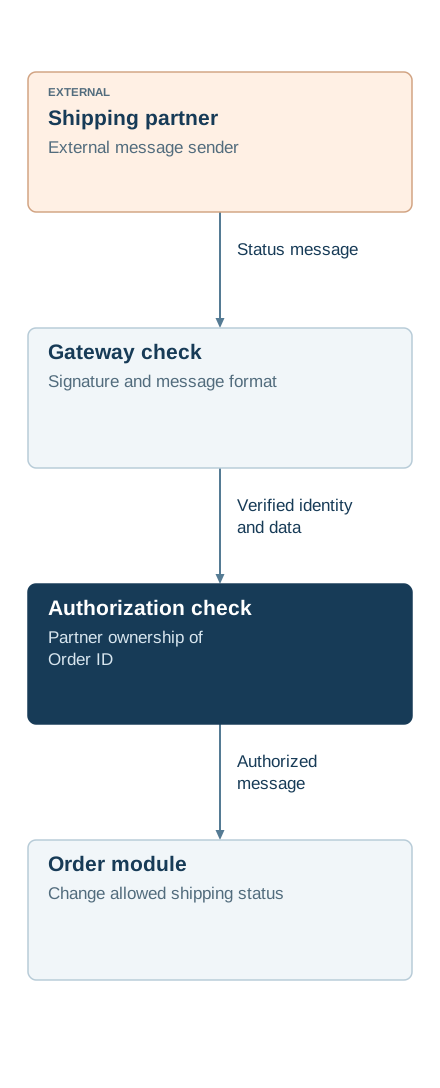
Verification trail of a shipment message
A shipping partner sends a tracking message to the shop. The shop verifies the signature and then checks whether the partner is allowed to update this order.
This is how you read the picture
- Boundary The “External” area: The “shipping partner” sends the status message.
- Signature The “gateway check” box: signature and message format.
- Permission The “Eligibility Check” box: Partner responsibility for the order identifier before the “Order Module”.
Read diagram as text
- Dispatch partner: External message sender (External)
- Gateway test: Signature and message format
- Authorisation check: Partner responsibility for order identifier
- Ordering module: Change the shipment status allowed
- Dispatch partner → Gateway test: Status message
- Gateway test → Authorisation check: Verified identity and data
- Authorisation check → Ordering module: Authorised notification
Benefits & limitations
Helps if:
- Data transitions between organisations, services or user contexts need appropriate control points.
- Multiple access paths and tenant relationships require clearly assigned responsibility for checks at every crossing.
Boundaries
- A check protects only paths that pass through it; direct administrative or message paths that bypass the gateway remain unprotected.
- A valid signature does not establish permission to act; Authentication and Authorisation answers the authorisation question.
- Every additional boundary adds checking effort and latency; it is useful where the Threat model identifies an attack path.
In practice
- Map data flows and changes in trust. Draw the source, recipient, return channel and identity context for a defined operation. Mark where control or permission assumptions change. This maps the relevant control points.
- Assign responsibility for each boundary check. Allocate identity verification, format validation, authorisation and tenant association to a specific component. Check that these controls run before any business effect. This makes assumptions and responsibilities explicit.
- Check access paths for bypasses. Compare synchronous, asynchronous and administrative routes and test whether the same business rules apply. Record missing controls as concrete changes. This shows where boundaries are technically enforced and where gaps remain.
Read the detailed explanation
A trust boundary separates areas whose actors or components operate under different security assumptions. At the crossing, identity, permitted actions, data format and tenant association must be checked appropriately. Boundaries may follow network, process or organisational boundaries; an internal address does not remove them. These checks connect to Authentication & Authorisation and Least Privilege.
The receiving component is responsible for the claims it accepts and the effects it triggers. Messages, files and administrative access also cross such boundaries. A data-flow overview helps identify control points and alternative routes. Controls must cover every entry point and distinguish technical trustworthiness from business authorisation. A boundary occurs where control or permission assumptions change, including within the same network. Its purpose is to verify expectations again before further business processing.
Zero Trust requires every request to be checked; network location alone establishes no trust.
Check your understanding
Test yourself in three stages
ReadingCheck in the picture
What check is directly in front of the order module?
View the solution with justification
The ‘eligibility test’. It clarifies the partner responsibility for the order identifier.
ApplyingTransferred to a new situation
The shipping partner sends a tracking message to B-1042. What steps does it go through before the order module changes status?
View the solution with justification
The gateway check controls signature and message format. Then the authorization checks whether the partner for B-1042 is responsible. Only then will the status be changed.
EvaluateWeighing an alternative
The team only checks the signature on the gateway and waives the authorization check. What speaks in favour, what speaks against?
View the solution with justification
For this: Less testing effort and a simpler path. On the other hand: The signature only occupies the sender. A partner with a valid signature could change orders for which he is not responsible.
Explore further
These building blocks continue the thoughts of this page.
References
- OWASP – Threat Modeling (opens in new tab)Leads through threat analysis with system model, attack surfaces and countermeasures.
- OWASP – Threat Modeling Cheat Sheet (opens in new tab)Shows confidence limits and data flows as the basis of threat analysis.
- NIST – Zero Trust Architecture (opens in new tab)Explains explicit trust decisions and the protection of individual resources.